
The health funds get most of the attention when people talk about insurers moving into care. But they are not the only ones. General insurers, life insurers and the workers compensation giants are all building, buying and backing digital health, just for very different reasons.
This piece maps who is doing what beyond the health funds, and argues that the incentive behind each move matters more than the press release attached to it.
Three different reasons to care about your health
Health funds are community rated. They cannot price an individual on their health, so their digital health play is about owning care and controlling claims cost: GP clinics, hospital-at-home, virtual care. That is a different game to the one the insurers in this piece are playing.
There are three engines at work here, and they explain why some of these bets look half-hearted and others look like core strategy.
Life insurers can price on health and behaviour, but they cannot pay for their customers' actual treatment. Their play is engagement: wellness apps that nudge healthier habits, reward them, and feed into premium discounts and a better risk pool. AIA Vitality is the textbook case.
General (P&C) insurers profit from fewer and smaller claims. Their play is prevention and early intervention: getting help to people before a moment of harm becomes a claim. IAG's investment in Sonder is the clearest example.
Workers compensation and personal injury insurers carry the cost of recovery directly. Their play is return-to-work and mental health recovery technology, and it is being driven by a sharp rise in psychological claims.
Same direction, three different economic motors.
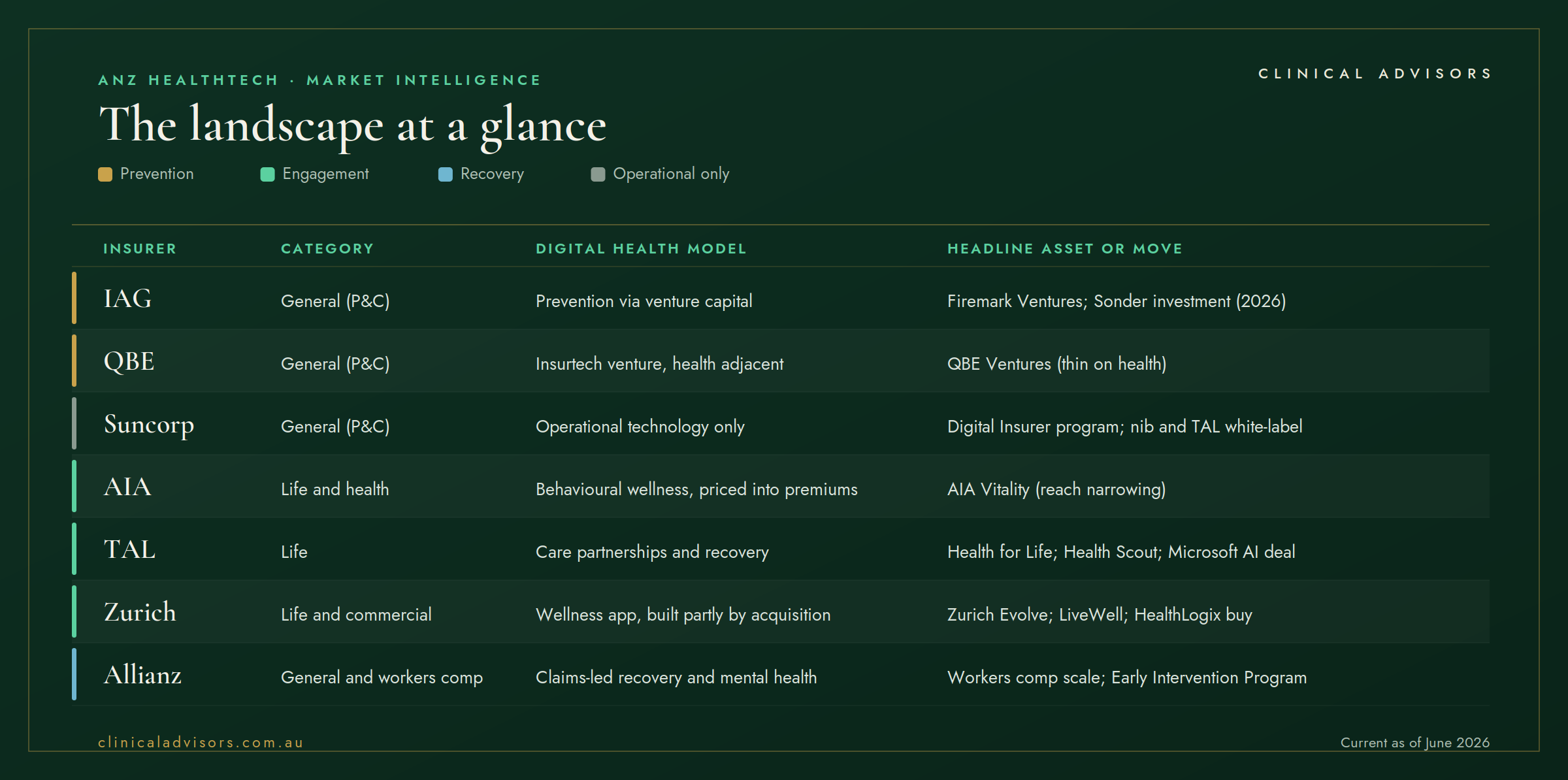
The landscape at a glance
Lane one: The venture and prevention plays
These are the general insurers proper. The activity is real but mostly sits at the edge of strategy, not the centre.
IAG is Australia and New Zealand's largest general insurer, with NRMA Insurance, CGU, WFI and ROLLiN' under its roof. Its corporate venture arm, Firemark Ventures, is the vehicle for anything that looks like digital health.
In June 2026 IAG took a strategic stake in Sonder, a 24/7 mental health, medical and safety platform it already used to support its own workforce. The plan is to extend Sonder to customers during high-risk moments: floods, cyclones, major incidents. The framing is explicit, a move from claims response towards earlier intervention and prevention.
Source note: this is the standout recent move, but Firemark's wider portfolio is mostly insurtech, climate and risk technology. Health is a thread, not the whole story.
QBE - QBE Ventures
QBE Ventures, founded in 2018 with a global remit and offices in Sydney and New York, has made around 25 investments. The portfolio leans heavily into insurtech and applied AI: cyber underwriting (Converge), document and decision AI (Lazarus AI), safety and risk management (Yellowbird), claims analytics (CLARA).
Source note: QBE's digital health angle is thin. The clearest signals are thought leadership, its emerging technology lead has spoken publicly on AI in emergency healthcare and first responder mental health, rather than actual health investments. They do act as a clearing-house of sorts when diverting members to external preferred services. If you are looking for a QBE digital health strategy, it does not really exist yet. Worth saying plainly.
Suncorp - Technology, not health
Now a pure-play general insurer after selling its bank and its New Zealand life arm, Suncorp's 560 million dollar Digital Insurer program is about platform modernisation (Duck Creek) and generative AI in claims and service (SunGPT, Single View of Claim).
Its health exposure is indirect. It white-labels health insurance through nib and life cover through TAL, and its CTP and personal injury arms fund injury recovery. There is no Suncorp digital health venture play to speak of. The digital spend is operational.
Lane two: The wellness ecosystems
This is where the real activity is. Life insurers can reward healthy behaviour and price for it, so wellness technology sits at the centre of strategy rather than the edge.
It is worth being clear about what these insurers cannot do, because it shapes everything they can. Life insurers are largely prohibited from funding their customers' medical treatment. Paying for hospital or general treatment is "health insurance business" reserved for APRA-registered health funds, and the Health Insurance Act 1973 blocks insurers from covering care that attracts a Medicare benefit. A life insurer cannot simply pay for a claimant's surgery or psychology sessions. What it can do is everything around the treatment: prevention, wellness, coaching and rehabilitation support that helps someone recover and return to work. So the apps and partnerships below are not just a strategic preference, they are largely what the rules allow. There is a long-running push to give life insurers a bigger role in funding rehabilitation, but for now the boundary holds.
AIA Vitality is the most established wellness program in the market: behavioural-science design, points and status tiers, wearable integration across Apple Health, Fitbit, Garmin and others, and premium discounts that scale with status. It is licensed from Discovery's global Vitality platform.
The honest nuance: it is not all expansion. AIA Vitality was withdrawn from some partner arrangements in 2026, with GMHBA closing it for members from 1 April 2026, and it is increasingly tied to holding an AIA life or health policy directly. The model works, but its reach through third parties is narrowing rather than growing.
TAL- The deepest care ecosystem
TAL, Australia's largest life insurer and owned by Dai-ichi, has built the most developed health proposition of any insurer outside the health funds. Its Health for Life framework spans prevention, claims support and recovery, and includes proprietary tools: Health Scout for risk awareness, Headlight for mental health, and Health Connector as a service directory.
The partnership list is long and clinical: SANE Australia for a peer support pilot aimed at income protection and TPD claimants, Remedy Healthcare for life coaching on mental health income protection claims, Valion Health (now under Spectrum Life) for cancer support, and SuperFriend on evidence-based wellbeing practice. In 2026 TAL went further, co-developing a digital mental health claims platform with Workcom and the University of Sydney, and signing its largest ever technology deal, with Microsoft, to build out AI capability.
TAL is also the only insurer with an external Medical Specialist Advisory Board. Of everyone here, TAL looks most like a health fund in its depth of care partnerships, just pointed at life and income protection claims rather than hospital cover.
Zurich - the one that invested its way in
Zurich, which has owned OnePath Life since 2019, runs two layers. Zurich Evolve is its Australian health and wellbeing proposition, backed by an in-house Health Services team of medical doctors and structured programs for cancer, pain, fatigue and mental health. LiveWell by Zurich is the global wellbeing app underneath it, organised around mind, body and community, with points, rewards and wearable linking.
The notable part: Zurich built LiveWell partly by acquisition, buying Australian digital health company HealthLogix in 2020. That is one of the few outright digital health acquisitions by any insurer in this group.
Lane three: Personal injury and workers compensation
This is the least glamorous lane and arguably the most real. Unlike life insurers, workers compensation and CTP insurers are required to fund their claimants' medical and rehabilitation costs, so their interest in recovery technology is direct and financial, not just reputational. They carry recovery costs on the books, and psychological claims have surged. Allianz reports its primary psychological claims have nearly doubled since 2019. That cost pressure is driving genuine investment in recovery and mental health tools.
Allianz is the largest workers compensation player nationally. It insures more than a quarter of the ASX 200 and operates in more jurisdictions than any competitor, including as a scheme agent for icare in New South Wales and within the Victorian managed fund.
Its digital health activity is claims-led: an early digital triage survey (MyJourney), an Early Intervention Program for mental injuries before liability is decided, a Claims Pharmacy partnership to streamline how injured workers access medication, and a long-running annual mental health research program with partners such as SuperFriend.
Source note: this is partnership and process innovation rather than ownership or venture investment, but it touches actual care more directly than most of the venture bets above.
Suncorp and the CTP recovery model
Suncorp's personal injury and CTP arms fund injury recovery, including exercise physiology, rehabilitation and return-to-work support. Structurally it mirrors Allianz: care funded and coordinated, not owned.
White space: What no one is really doing
Owned care delivery. No general or life insurer owns clinics or care delivery the way Medibank and Bupa do. Their model is prevention, partnership and claims technology. The closest are TAL's partnership depth and Zurich's in-house medical team, but neither owns delivery.
A wellness program that actually retains people. Vitality-style programs face a persistent engagement problem, and AIA's partial retreat in 2026 suggests the economics are not guaranteed. There is room for a wellness proposition that people genuinely stick with.
Joining prevention to pricing, credibly. Life insurers can in theory link healthy behaviour to premiums, but the data, fairness and regulatory questions around wearables and underwriting remain unresolved. Whoever solves that cleanly has an edge.
Mental health recovery at scale. The workers compensation data makes this the most urgent gap. Psychological claims are rising fast, recovery is slow and fragmented, and the current tools are early. TAL's University of Sydney platform and Allianz's early intervention work are the most serious attempts, and both are recent.
Venture money with a health thesis. Firemark and QBE Ventures are active, but health is a minor thread in portfolios dominated by insurtech, cyber and climate. No general insurer venture arm has a clear digital health thesis the way HCF Catalyst once did for the health funds.
Terry Cornick is a healthtech strategist, commercial growth expert and the founder of Clinical Advisors. This analysis draws on publicly available information and company announcements current as of June 2026. Contact us to to find out more about our services.
