
Every nation in the FIFA World Cup is playing for a trophy. In the Healthtech World Cup, they are playing for something else. Each real fixture also gets a healthtech verdict, and the country with the stronger digital health ecosystem wins on our scoreboard, whatever happens on the pitch. The gap between the two results is the whole point of the exercise.
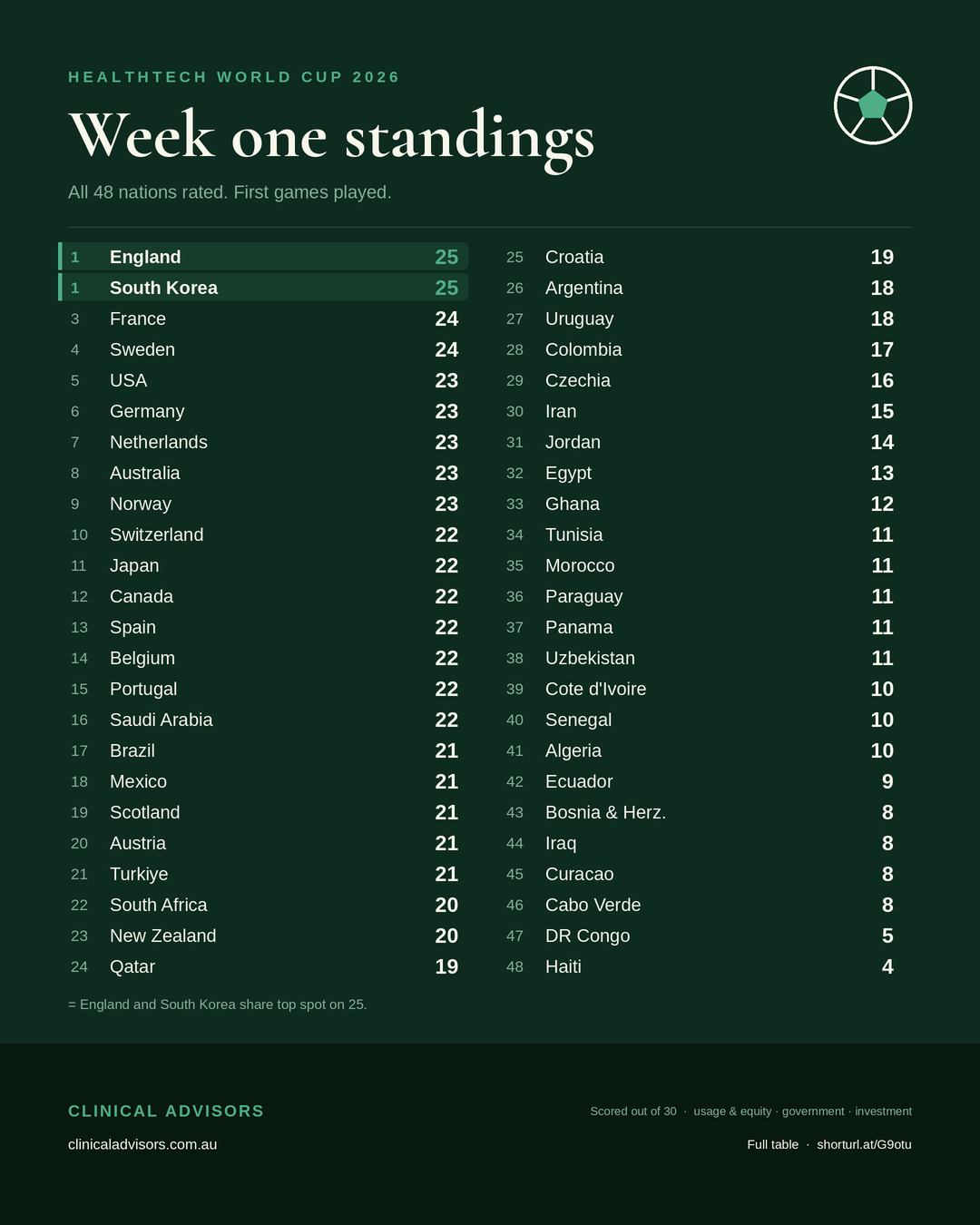
Week one is now complete. All 48 teams have played their opening game, and all 48 have a score on the board. Here is where the world stands, and why the healthtech table looks nothing like the football one.
How the scoring works
Every nation is rated out of 30, across three factors worth ten points each.
The first is population usage and equity: how widely digital health is actually adopted, and how fairly that access is spread. The second is government: the seriousness of the national strategy, the funding behind it, and the infrastructure that results. The third is investment: the capital flowing into healthtech, domestic and foreign. A strong country needs all three. Money without a system, or a system without adoption, only gets you so far.
The leaders
Two nations share first place on 25, and they got there by opposite routes.
South Korea built its lead on near-total digital adoption and a single, connected national system that most countries can only dream of. England built its lead on the NHS, the NHS App now in tens of millions of pockets, and London, the second largest healthtech investment hub on earth behind the United States. One country leads on structure, the other on a blend of structure and sheer capital, and they meet at the top.
France and Sweden sit a point behind on 24. Both are quietly excellent at the hardest part of digital health, which is joining the money to the method. France poured billions into its Segur du Numerique programme and rolled a national health record out to the whole population. Sweden runs some of the most complete national health data systems anywhere.
Money is not the same as a system
The most useful lesson in the table sits just below the leaders.
The United States has more healthtech capital than most of the rest of the field combined, the deepest startup bench in the world, and genuine leadership in AI and devices. It still sits in a pack on 23. The reason is structural. There is no universal system, records are scattered across thousands of providers and payers, and access depends heavily on your insurance. All the money, not enough of the chassis.
Sweden, Norway and the Netherlands make the opposite case. Less capital, far more coordination, and a place near the top regardless. In healthtech, organisation compounds.
The quiet overachievers
Some of the most interesting stories are nations punching well above their size.
Turkiye sits on 21, carried by e-Nabiz, one of the most used national health records on the planet, with tens of millions of citizens logging in to read their own data. Croatia lands on 19 thanks to a national backbone, CEZIH, that runs more than 60 million e-prescriptions a year and connects almost every provider in the country. Uruguay reaches 18 on the strength of one of Latin America's most advanced electronic health records. Saudi Arabia hits 22 on the force of Vision 2030 and the world's largest virtual hospital.
And even in the thinnest markets, talent finds a way through. Senegal, near the bottom of the table on the basics, is home to Kera Health, an AI platform built by one of Africa's leading scientists and backed by the World Bank's investment arm. The ecosystem can be small and the brilliance still real.
Football pedigree is not healthtech
This is the part worth holding onto.
Argentina win World Cups. On healthtech they sit mid-table on 18, their digital health scene starved by years of economic turmoil. Brazil leads Latin America but lands on 21. The nations that lift trophies on grass are simply not the nations leading on health, and the two tables refuse to line up.
The opposite is just as true. Plenty of teams that will not trouble the football knockouts are powerhouses on our board, because they built systems while others built squads.
The bottom of the table
At the foot sit Haiti and DR Congo, on 4 and 5. These are systems operating in the hardest conditions anywhere, carried largely by donors and NGOs rather than the state, doing remarkable things with almost nothing. The distance between the top of this table and the bottom is the single most important number in the whole project, and a reminder of what digital health is ultimately for.
What week one tells us
One round in, the shape of the league is already clear, and so is the headline. The football champion and the healthtech champion are not going to be the same country. As the group stage continues, the table will keep moving, and the gap between reputation and reality will keep showing up.
The full 48-team table and every score are live and updated as we go - click here to view.
International healthcare brand eyeing the ANZ market? Clinical Advisors helps companies land and grow here. Get in touch here.
