
Australia's aged care sector is in the middle of the most disruptive decade in its history. A new Aged Care Act. Strengthened Quality Standards effective November 2025. Tightening care minute requirements. A workforce crisis that isn't going away. And a demographic wave that is only accelerating, with the over-85 population projected to reach 794,200 by 2030-31.
Against that backdrop, the sector's largest operators are being forced to make a call, invest in technology as a strategic lever, or adopt it defensively to stay compliant. The answer, it turns out, depends on who you're asking.
This piece maps what Australia's five largest residential aged care operators are actually doing in digital health and technology, based on publicly available information as of mid-2026.
Opal HealthCare - scale without a public tech story
Opal is Australia's largest aged care operator, a position cemented by its acquisition of BlueCross in 2024 which took its portfolio to 132 homes. Pacific Equity Partners committed approximately $1 billion to back the business, making it one of the largest private equity positions in Australian aged care.
The capital story, however, is largely about beds and buildings rather than technology. Publicly, Opal's digital health footprint is thin. The most notable recent tech partnership is a content integration deal with Swift Networks for in-facility TV services. Their website references ROMPA augmented reality projectors trialled in care communities from 2019, and FaceTime infrastructure rolled out during COVID, neither of which constitutes a digital health strategy.
Internally, Opal runs an Opal Academy for workforce development, including digital credentialling, and Microsoft SQL Server appears in their tech stack. Beyond that, there is little on the public record about clinical systems investment, remote monitoring, or care platform strategy.
This is either a gap or a deliberate choice to keep technology activity out of the public narrative while focusing on operational scale. Either way, for a business of this size, the absence of a visible digital health story is itself noteworthy.
In short: Largest operator. Quietest on tech.
Bolton Clarke - The research and innovation model
Bolton Clarke is Australia's largest independent not-for-profit aged care provider, operating across residential, home care, and retirement living. Its roots, RSL Care Queensland and the Royal District Nursing Service Victoria, give it a clinical heritage that has translated into one of the most active research and innovation functions in the sector.
The Bolton Clarke Research Institute has been running for nearly 25 years. Its 2025 report covers co-designed solutions, dementia care models, evidence implementation, and innovations spanning AI, VR, apps, and avatar-based tools. The organisation describes internationally recognised work in digital independence products under the Bolton Clarke InTouch brand, and has an in-house Digital and Technology Management function specifically tasked with deploying innovative solutions across at-home support, retirement living, and residential care.
Governance reflects the priority: the Bolton Clarke board has a dedicated Innovation and Technology Committee, and the board's chairman sits on it. That is relatively unusual in Australian aged care.
Bolton Clarke also commissioned an external Innovation Hub Framework, a five-stage process from innovation intake to implementation, to embed technology adoption into organisational culture rather than treating it as a series of one-off projects.
The gap is commercialisation. Bolton Clarke has strong institutional infrastructure for innovation but is less visible on specific product partnerships or vendor integrations compared to some peers.
In short: The research and governance model. Better infrastructure for innovation than most; fewer specific tech deployments on the public record.
Estia Health - New ownership, new chapter
Estia Health has been the sector's most active M&A story. Bain Capital acquired the business for $838 million in December 2023 and grew it from 73 homes to 93 homes and approximately 9,250 residents before announcing in May 2026 that it had agreed to sell to Stonepeak, an alternative investment firm. The transaction is expected to complete in late 2026.
On technology, the Bain period was growth-focused rather than digital-health-focused. Estia invested in electronic health records and telehealth infrastructure, with an internal tech stack leaning on Microsoft tools. There is no evidence of a proprietary digital health product or a publicised technology strategy.
What Stonepeak brings to the technology agenda is an open question. The firm is infrastructure-focused and its appetite for digital health investment in aged care is not yet on the public record.
In short: Biggest ownership change in the sector in 2026. The technology story remains unwritten.
Regis Healthcare - The most transparent tech investor
Regis is the sector's only ASX-listed aged care provider, which means its technology activity is documented in investor presentations and annual reports in a way no privately held competitor can match.
The FY25 investor presentation is the most specific public technology disclosure in Australian aged care. It called out:
Continued progress on replacing and improving aged care clinical and care management systems
Implementation of AlayaCare as a new and improved technology platform for the home care business
Completion of HR system investments covering time and attendance, recruitment, and HRIS
A clear technology roadmap in the FY25–FY27 strategic plan
AlayaCare is notable. The Canadian-origin platform is one of the leading home care management systems in ANZ, covering scheduling, clinical documentation, billing, and outcomes tracking. Deploying it across a home care operation of Regis's scale is a material investment, not a pilot.
Regis's revenue reached $1.16 billion in FY25, growing 30% year-on-year, a business scaling fast enough that technology investment is becoming a commercial necessity, not just a compliance response.
In short: The best-documented technology story of the five, courtesy of the ASX. AlayaCare is the standout implementation.
Bupa Aged Care - Scale and scrutiny
Bupa is the only operator on this list that sits inside a larger health business, and it shows. The Bupa Aged Care technology story cannot be separated from the broader Bupa connected care strategy, which includes the Blua digital health platform, the Umps remote in-home monitoring investment (via Bupa Ventures), and the Mindplace mental health clinic network.
In June 2025, Bupa appointed a new digital health leader, a clinician with emergency medicine experience and a background spanning multiple countries in digital health implementation. That appointment signals intent to strengthen the digital capability across Bupa's Australian operations including aged care.
The other 2025 headline was less welcome. Echo Law launched a class action against Bupa Aged Care targeting systemic issues across its 57 homes. The reputational and operational pressure this creates is relevant context: technology investment in Bupa's aged care operations is happening alongside, not instead of, significant scrutiny of care quality.
The Umps investment, remote in-home monitoring for older Australians, is the most relevant healthtech call-out for the aged care operation specifically. It fits the Bupa model of using technology to extend care beyond facility walls.
In short: The most connected to a broader health technology ecosystem. Also the most exposed to regulatory and legal pressure in the current environment.
Reading across the five
What these operators share is a common forcing function: the new Aged Care Act, the Strengthened Quality Standards, and the AN-ACC funding model are creating compliance pressure that technology partially solves. Care minutes, clinical documentation, and workforce management are the immediate use cases.
What they do not share is a strategic orientation. Two broad models are emerging:
Compliance-driven adoption: Technology deployed to meet regulatory requirements, reduce risk, and improve operational efficiency. Estia and Opal sit here, based on the public record.
Innovation infrastructure: Organisations building the capability to systematically test, evaluate, and deploy technology at scale. Bolton Clarke and Regis sit closer to this, for different reasons.
Bupa straddles both: Genuinely connected to a broader digital health ecosystem, but operating under conditions that make bold innovation harder.
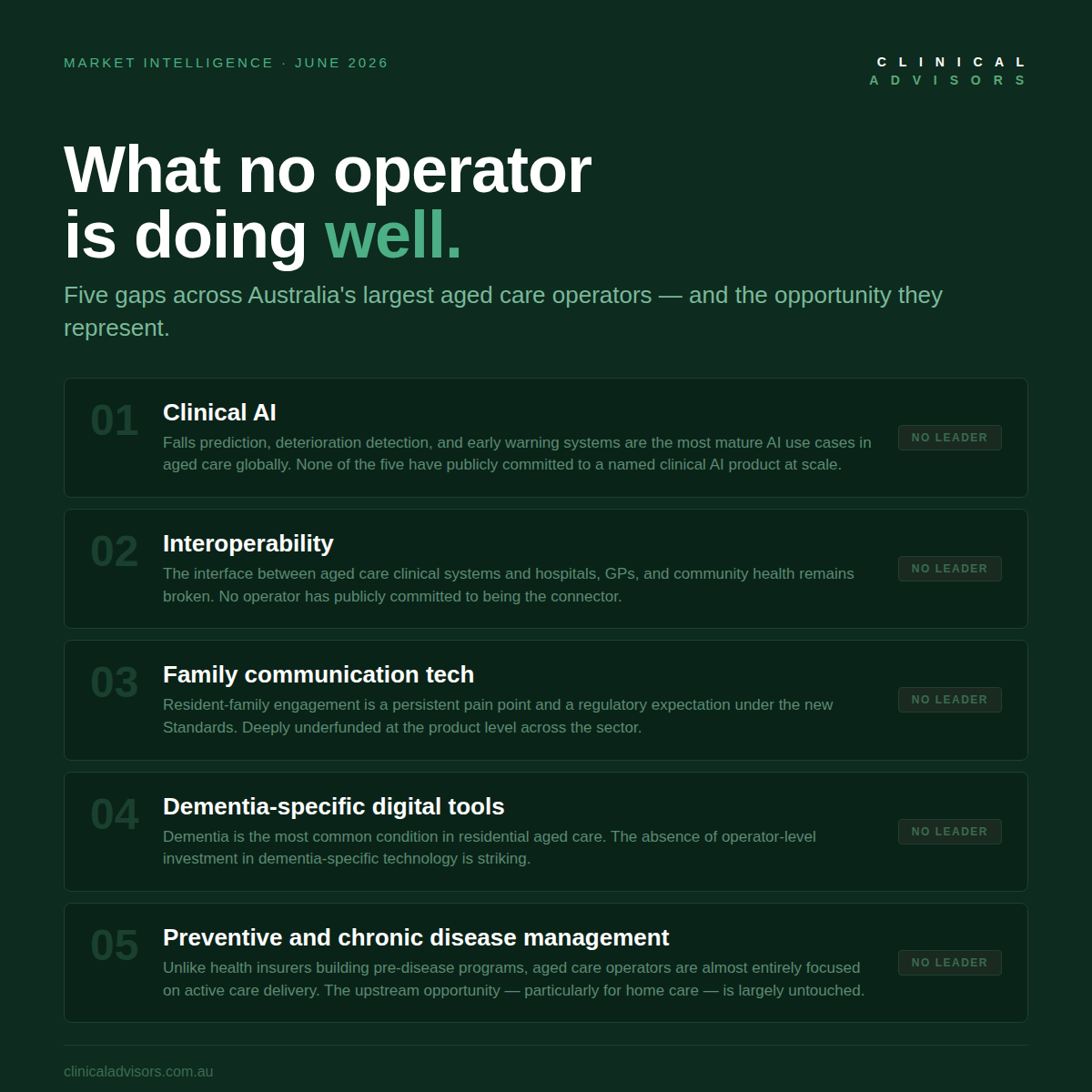
What no operator is doing well
Across the five, several gaps remain:
Clinical AI: Falls prediction, deterioration detection, and early warning systems are the most mature AI use cases in aged care globally. None of the five have publicly committed to a named AI clinical product at scale.
Interoperability: The interface between aged care clinical systems and hospitals, GPs, and community health remains broken. No operator has publicly committed to being the connector.
Family communication tech: Resident-family engagement is a persistent pain point and a regulatory expectation under the new Standards. It is also deeply underfunded at the product level across the sector.
Dementia-specific digital tools: Given that dementia is the most common condition in residential aged care, the absence of operator-level investment in dementia-specific technology is striking.
Preventive and chronic disease management: Unlike health insurers who are building pre-disease programs, aged care operators are almost entirely focused on active care delivery. The upstream opportunity, particularly for home care, is largely untouched.
The honest summary
Australia's aged care sector is digitising. It is doing so under pressure, with limited margins, and a workforce crisis that makes every operational improvement matter. The technology story is less about innovation and more about keeping up, with regulation, with rising resident expectations, and with a funding model that increasingly rewards efficiency.
The operators who come out ahead will be those who treat technology as organisational infrastructure rather than a compliance checkbox. On current evidence, Bolton Clarke has the “best” innovation architecture. Regis has the most transparent technology investment. Bupa has the most connected ecosystem. Opal has the most capital and the most to prove.
Terry Cornick is a healthtech strategist and the founder of Clinical Advisors. This analysis draws on publicly available information and company announcements current as of June 2026. Reach out here to discuss further.
